The Best CMS for Business Websites in 2023.

In today’s digital landscape, having a strong online presence is essential for businesses of all sizes.

A well-designed and user-friendly website is crucial for connecting with customers, building brand awareness, and driving sales. Choosing the right content management system (CMS) for your business website can be a daunting task, with many options available. However, in 2023, WordPress continues to be the top choice for businesses looking to establish a strong online presence.

In this post, we will explore the reasons why WordPress is the best CMS for business websites in 2023, including its user-friendly interface, customisable options, SEO-friendly features, responsive design, cost-effectiveness and scalability. We will also discuss how you can take your online sales potential to the next level by integrating an eCommerce functionality with WooCommerce and how it compares to other alternatives. Whether you’re a small business just getting started or a larger enterprise looking to revamp your website, this post will provide valuable insights into why WordPress is the best choice for your business in 2023.

Businesses love WordPress CMS for its user-friendly interface.

One of the key benefits of using WordPress as your CMS is its user-friendly interface. The platform is designed to be easy to navigate and use, even for those with little to no technical expertise. The interface is simple and intuitive, making it easy for users to create and manage their website without needing to know how to code.

The WordPress dashboard is organised and intuitive, allowing users to easily access and manage the different aspects of their website, such as creating and editing pages and posts, managing media, and controlling settings. Additionally, the platform offers a wide range of tutorials and documentation, making it easy for users to learn and understand how to use the system.

Another benefit  WordPress offersis the wide range of user-friendly templates and themes that can be easily customised to suit the specific needs of your business. These templates and themes are designed to be responsive, which means they automatically adjust to fit the screen size of the device they are being viewed on. This feature is particularly important in today’s digital landscape, where more and more people are browsing the internet on their mobile devices.

WordPress’s user-friendly interface makes it a great choice for businesses of all sizes looking to establish a strong online presence. Its simple and intuitive interface, wide range of tutorials and documentation, and responsive templates and themes make it easy for users to create and manage their website, regardless of their technical expertise.

The ultimate customisation experience with WordPress’s wide range of options.

Another key benefit of using WordPress as your content management system is the wide range of customisable options it offers. Whether you’re a small business just getting started or a larger enterprise looking to revamp your website, WordPress offers a variety of customisable options to fit the unique needs of your business.

One of the most popular ways to customise a WordPress website is by creating a customised child theme. This allows developers to quickly modify one of the many WordPress themes available and give you a unique look to suit the specific needs of your business.

Another great way to customise your WordPress website is by using plugins. WordPress offers a vast library of free and paid plugins that can be easily installed and activated to add additional functionality to your website. These plugins can be used for anything from adding contact forms to optimising your website for search engines. They are a great way to add complex functionality without a huge increase in cost.

In addition, WordPress also offers a range of customisation options for the back-end, such as custom post types and fields, which allow you to create custom content and manage it in a way that fits your specific needs.

Finally, because WordPress is open source a capable developer has full control to modify it as required to meet the exact needs of your business. Giving the the ultimate flexibility provided you have the budget for custom development.

WordPress’s wide range of customisable options makes it an ideal choice for businesses of all sizes looking to establish a strong online presence.

Maximise your online visibility with WordPress’s SEO-friendly features.

One of the key benefits of using WordPress as your content management system is its SEO-friendly features. WordPress is built with search engine optimisation (SEO) in mind, which means it is optimised for search engines. This makes it easier for your website to rank higher in search engine results, which can help drive more traffic to your site.

  • WordPress has several built-in SEO-friendly features, including:
    Clean, semantic code that is easy for search engines to crawl and index
  • The ability to create custom permalinks, which help search engines understand the structure of your website and the relationship between pages
  • Built-in support for meta tags, which provide information about your website to search engines and can help improve your website’s visibility in search results.
  • The ability to easily create and manage XML sitemaps, which help search engines understand the structure of your website and the relationship between pages.

Additionally, there are also several popular SEO plugins available for WordPress such as Yoast SEO, All in One SEO Pack, and Rank Math, that provide additional features and functionality to help improve your website’s visibility in search results.

WordPress’s SEO-friendly features are another reason it is a great choice for businesses looking to establish a strong online presence. Its clean semantic code, customisable permalinks, built-in support for meta tags, and support for XML sitemaps and plugin options can help improve your website’s visibility in search results, which can help drive more traffic to your site.

Save on costs with WordPress’s open-source technology.

One of the key benefits of using WordPress as your content management system is its cost-effectiveness. WordPress is open-source software, which means it is free to use, many other CMS systems come with high monthly charges just to use the platform. Because of this it is a great choice for small businesses who need to keep costs to a minimum.

Using an open-source software like WordPress also means that you have access to a large community of users who are constantly contributing to the platform by creating new themes, plugins, and resources. This can help you to save on costs by utilising the available free options instead of having to pay for expensive proprietary software or custom development.

Moreover, using WordPress can also help lower your hosting and maintenance costs, as it is a lightweight and efficient platform that can run on most web hosting services.

In summary, WordPress’s open-source technology and the wide range of themes, plugins and resources available make it an ideal choice for businesses looking to establish a strong online presence on a lower budget. Using WordPress can help keep build costs costs low, and lower your ongoing hosting and maintenance costs.

Easily scale your website with WordPress’s flexible platform.

Another key benefit of using WordPress as your content management system is its scalability. WordPress is a powerful and flexible platform that can be scaled up or down to meet the needs of businesses of all sizes. It can handle a large volume of content, traffic, and users, making it a suitable choice for businesses of any size.

WordPress has a wide range of options that help make it scalabile. Features such as caching and optimisation plugins can be used to improve the performance and speed of your website, even under high traffic loads. Additionally, it can be easily integrated with other platforms and services to expand its capabilities and handle more traffic, such as cloud hosting services, Content Deliver Networks (CDN), and more.

Moreover, WordPress has a built-in multisite feature that allows you to run multiple sites from a single installation, this feature can be very useful for businesses that have multiple websites for different purposes, departments or branches.

In summary, WordPress’s scalability makes it an ideal choice for growing businesses looking to establish a strong online presence. Its powerful and flexible platform can handle a large volume of content, traffic, and users, and it can be easily scaled up or down to meet the specific needs of your business, with caching and optimisation plugins, integration with other platforms and services, and the handy built-in multisite feature.

Maximise your online sales potential with WooCommerce: The ultimate eCommerce solution for WordPress.

WooCommerce is a popular eCommerce plugin for WordPress that allows you to easily add an online store to your business website. It is built specifically for WordPress and integrates seamlessly with the platform, making it an ideal choice for businesses looking to expand their online presence to include eCommerce functionality.

One of the key benefits of using WooCommerce is its ease of use. The plugin is designed to be user-friendly, and it is easy to set up and manage an online store without needing to have any technical expertise. You can easily add products, set up payment options, and manage orders and customers.

WooCommerce also offers a wide range of customisation options, allowing you to tailor your online store to fit the unique needs of your business. You can choose from a variety of themes, customise the checkout process, and add various extensions and plugins to improve the functionality of your store.

Another benefit of using WooCommerce is its scalability. The plugin is designed to handle a reasonably large volume of products, traffic, and customers, making it a suitable choice for most new Zealand Businesses. It also supports a wide range of payment options, including popular payment gateways like Windcave, PayPal and Stripe.

In addition, WooCommerce is also SEO-friendly, which means it is optimised for search engines. This can help your online store rank higher in search engine results, which can drive more traffic to your site.

Furthermore, it’s cost-effective, WooCommerce itself is free to use. And, there are many free and paid extensions available that can add additional functionality to your store, such as shipping and tax options, inventory management, and more.

In summary, WooCommerce is the ultimate eCommerce solution for businesses using WordPress. It’s ease of use, wide range of customisation options, scalability, support for various payment options, SEO-friendly features, and cost-effectiveness make it a great choice for businesses looking to expand their online presence to include an online store. With WooCommerce, you can easily set up and manage your online store, tailor it to fit your unique needs, and drive more sales for your business.

Why WordPress stands out among other Content Management Systems.

While there are many content management systems available, WordPress stands out for its user-friendly interface, customisable options, SEO-friendly features, responsive design, cost-effectiveness, and scalability. Here, we will take a look at some of the other popular alternatives to WordPress and compare them based on these key features:

  1. Webflow: Webflow is a website design and development platform that allows users to design, build, and launch responsive websites without writing code. While it offers a user-friendly interface and customisable options, it does not have the same level of SEO-friendliness and scalability as WordPress.
  2. Squarespace: Squarespace is a website building platform that allows users to create professional-looking websites with its drag-and-drop interface. It also offers a range of customisable options, but it lacks the same level of scalability and SEO-friendliness as WordPress.
  3. Wix: Wix is a website builder that allows users to easily create websites with its drag-and-drop interface. It offers some customisation options and a lot of templates, but it lacks the same level of customisation, scalability and SEO-friendliness as WordPress.
  4. Joomla: Joomla is another open-source content management system that offers a range of customisable options, but it is not as user-friendly as WordPress. Additionally, it is not as SEO-friendly as WordPress.
  5. Drupal: Drupal is another open-source content management system that offers a range of customisable options, but it is also not as user-friendly as WordPress, it is best suited for large companies with developers on staff, or a Web agency on a retainer to make any changes required.

In comparison, WordPress stands out as the clear winner when it comes to all around ability.

Conclusion: WordPress is the best choice for building a business website in 2023.

WordPress is the best choice for building a business website in 2023 due to its user-friendly interface, customisable options, SEO-friendly features, responsive design, cost-effectiveness, and scalability. It’s the top choice for businesses looking to establish a strong online presence and should be first on your list to consider.

Our team of experts can help you plan, design, and develop a custom WordPress site.

So, if you’re looking for a content management system that will help you establish a strong online presence for your business, WordPress is an excellent choice. But with so many options and customisation available, it can be overwhelming to plan, design, and develop a custom WordPress site on your own.

That’s where Forge Creative comes in.

We’re experts at web design, our team can help you plan, design, and develop a custom WordPress site that meets the needs of your users, builds your brand, and creates lasting value for your business. We understand the importance of creating a website that is both visually appealing and easy to navigate, and we’ll work closely with you to ensure that your website is tailored to your specific needs.

So if you’re ready to take your business to the next level, contact us today and let’s work together to create a website that will help you reach your goals!

Frequently Asked Questions (FAQ’s)

  1. What makes WordPress the best choice for building a business website in 2023?
    WordPress offers a user-friendly interface, customisable options, SEO-friendly features, responsive design, cost-effectiveness, and scalability, which makes it the best choice for businesses looking to establish a strong online presence.
  2. How is WordPress user-friendly?
    WordPress is designed to be user-friendly, even for those with little to no technical expertise. It offers a simple and intuitive interface that makes it easy to create and manage a website without needing to know how to code.
  3. How does WordPress help with SEO?
    WordPress is built with SEO in mind, which means it is optimized for search engines. This makes it easier for your website to rank higher in search engine results, which can help drive more traffic to your site.
  4. Can I add eCommerce functionality to my WordPress website?
    Yes, you can use the popular eCommerce plugin WooCommerce, which is built specifically for WordPress and integrates seamlessly with the platform, making it an ideal choice for businesses looking to expand their online presence to include eCommerce functionality.
  5. How does WordPress compare to other alternative Content Management Systems?
    WordPress stands out as the clear winner when compared to other alternative Content Management Systems, as it is user-friendly, customisable, SEO-friendly, responsive, cost-effective, and scalable. Additionally, WordPress has a large community of users and developers, which means that it has a wealth of resources, support and updates readily available.


Let us help you breathe a new life into your EDM strategy.

Contact Form - Email Marketing. Effective or outdated?
Subscribe to newsletter

Email Marketing. Effective or outdated?

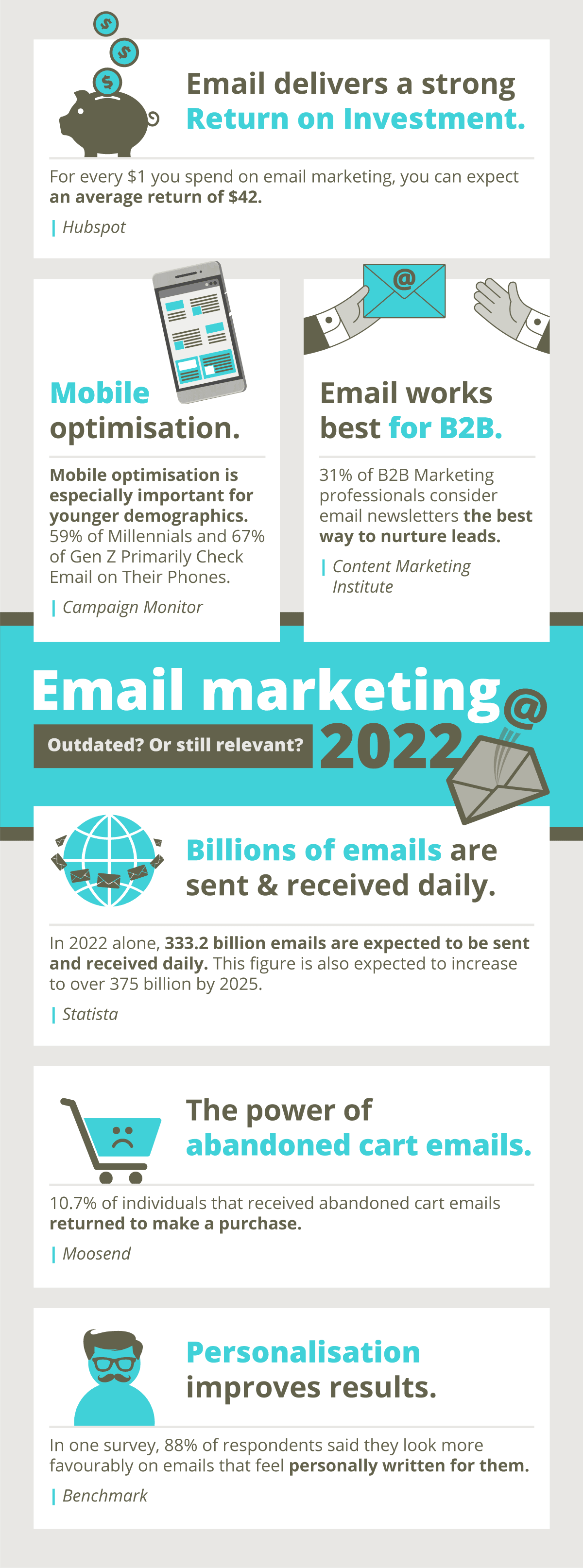
1. Email delivers a strong Return on Investment

I remember attending a direct marketing conference a while back. The presenter said that the effectiveness of targeted communications could be broken down as follows:

  • 60% targeting the right audience
  • 30% delivering the right offer
  • 10% creative.

Suffice to say that since the presentation was to a bunch of copywriters and designers, the room quickly erupted into an uproar. But deep down, we knew what he was saying was right. Delivering the right message to the right people is what targeted marketing is all about. All the rest, as they say, is propaganda.

It should be what email marketing is all about. Many a marketer has fallen into the trap of thinking just because they have a list of email addresses, they can say whatever to whomever.

Not so. That’s just mass marketing using someone’s name.

In fact, in a cluttered environment where it’s damnably easily to just push “delete”, delivering the right message to the right audience is more important than ever.

Email marketing can be an effective tool in your marketing toolbox. But only if it’s used wisely. And that means thinking the 60/30 rule – finding the audience who wants or needs your product or service and conveying the offer that will push their buttons.

With that little caveat ringing in your ears, we’ve assembled some useful stats and interesting tips around the world of email marketing. (As you read, just keep on repeating the mantra: “right offer to the right audience, right offer to right audience…”)

It’s no surprise given the immense popularity and undeniable benefits of Email Marketing that this is a form of investment that brings a huge return on investment (ROI).

For every $1 you spend on email marketing, you can expect an average return of $42. (Hubspot)

According to a study by Hubspot, email marketing is the king of online marketing channels.

There are many other benefits, but this one comes first in keeping your business stable and growing.

2. Billions of emails are sent daily – so why should they read yours?

In 2022 alone, 333.2 billion emails are expected to be sent and received daily (Statista, 2021).

This figure is also expected to increase to over 375 billion by 2025 – That’s an incredible amount of daily emails.

Over the years, many new forms of communication have emerged. Despite this appearance, Email Marketing is still going strong and is continuing to grow. With this Email Marketing metric, it’s hard to ignore the potential of a great email marketing campaign. The key of course is ensuring it’s relevant to your target audience so you can connect with them and form an ongoing relationship.

3. The power of ‘abandoned cart’ emails.

10.7% of individuals that receive abandoned cart emails return to make a purchase (Moosend)

Retargeting consumers who leave online shopping carts can help websites regain lost customers. Considering that the open rate for cart abandonment is an impressive 45%, you can expect 10.7% of shoppers to purchase the product.

So, are purchase reminder emails working? Statistics are here to support this claim. Emails sent an hour after cart abandonment provide better returns. Sending three cart abandonment emails delivers 67% better results than one cart abandonment email.

Lead retargeting makes sense because more than 50% of consumers will buy something after sending out a marketing email at least once a month.

4. Personalisation improves results.

Emails with a certain personalised email subject line will get noticed. A comprehensive study by the publishing company, Marketing Dive, shows that personalised email offers 21% open rates compared to 14% open rates on non-personalised emails.

Emails that provide a personal touch lead to 58% higher click-to-open rates. A personalised subject line will also dramatically increase a campaign’s KPIs. In one survey, 88% of respondents said they look more favourably on emails that feel personally written for them. (Benchmark)

5. Mobile optimisation.

Mobile is the most widely used environment for checking email. More than 80% of smartphone users regularly check their email using their smartphones. But nearly one in five email campaigns are not optimised for mobile devices. (Hubspot) If your emails aren’t mobile-first or at least mobile-optimised, you’re missing out on many potential connections, customers, leads and sales. It will also raise the bounce rate due to poor user experience.

Mobile optimisation is especially important for younger demographics. 59% of Millennials and 67% of Gen Z primarily check email on their phones. (Campaign Monitor)

6. Email works best for B2B.

Email is the place for serious conversations, which hits the B2B gold spot. That, along with the unbeatable 4,200% ROI, makes email one of the most important marketing channels for B2B companies.

31% of B2B marketing professionals consider email newsletters the best way to nurture leads. (Content Marketing Institute)

It takes time and effort to successfully plan a B2B email marketing campaign but the investment is worth it. Valuable periodic newsletters to customers are the best way for you to stay engaged with potential customers. But when it comes to choosing this approach, you need to have the right content strategy in place to steer your customers down the path to conversion.

The above statistics for 2022 still show the effectiveness of your email marketing strategy.

So is email marketing outdated?

No, It’s incredibly relevant and an essential channel for your marketing efforts. We’d say that it’s your email marketing strategy that is outdated.

Let us help you breathe a new life into your EDM strategy.

Contact Form - Email Marketing. Effective or outdated?
Subscribe to newsletter

5 ways to build your brand value.

Here are some ways you can build that valuable value into your brand.

1. Create a wonderful customer experience.

If you’re selling products (especially online), make it easy for customers to buy from you. Speed and convenience are key.

If the simple act of making a purchase becomes too complex, people will start looking elsewhere. And back it all up with a good customer service team.

2. Understand who your target audience is.

That way you’ll know what to say to them. Know their needs and appeal to those needs, both in terms of products and services, and how you promote those products and services. Don’t just talk about product features in your ads (or on your website); push the benefits that tap into your customers’ emotions.

Knowing your audience helps you to target your communications more effectively too. Instead of casting a wide net, channel your marketing to where your target audience lives.

3. Be remarkable (and tell everyone).

This is where you identify the big benefits of your product or service and make a really big deal of them. The happiest employees. The most innovative thinkers. The best customer service. The biggest range.

Focus on the superlatives. It’ll build a stronger brand value and help you stand out from the crowd.

4. Maintain a consistent tone of voice.

Like your brand values, your tone of voice needs to stay the same.

Using the same tone, language and opinions across your various market touchpoints (from the way employees speak to customers, to the way your website talks to customers) eliminates confusion about what your brand is all about – and helps your audience to bond with you.

5. Keep your design to a high standard.

People are visual creatures. They’ll determine whether your brand is valuable or not by what they see.

You may be a small business, but using a strong, visual branding system can make it seem more powerful and create a whole lot of positive messages in your audience’s mind.

On the other hand, bad design can destroy your brand value. And all that other hard work you’ve done to build your brand will go down the drain.

Get a quote for branding advice & implementation.

Let’s talk about how we can help you add value to your business by transforming your business name into a valuable brand.

Contact Form - 5 ways to build your brand value
Subscribe to newsletter

Walking in skins and Homegrown UX Design.

“You never really understand a person until you consider things from his point of view, until you climb into his skin and walk around in it.”

Atticus Finch: To Kill a Mockingbird

Okay, Finch was talking about far weightier things than website design when he gave his daughter that little pearler. But the fact is, those words of wisdom should be a guiding light when you start to build your website – or any customer interface for that matter.

Why? Because if you don’t know how your prospective user will feel or act when they start interacting with your interface, chances are they’ll give up and move on before you’ve had a chance to get your message across.

UX, or User Experience Design, is all about designing a website with your user’s needs front and centre. It provides positive experiences that keeps users loyal to your product, service or brand. It creates a meaningful user experience, which in turn allows you to take a customer on the journey that both they (and you) want to go on.

User Experience is different for everyone. The most important thing to remember is that you are not your users. Don’t assume you know what they want or need.

Get close to your users. Understand what makes them tick. As Atticus says, “climb into their skin and walk around it in.”

So how can this skin walking be achieved?

Here at Forge, we follow these steps to create effective Homegrown User Experience Designs.

1. Button down user profiles and personas.

This is where you get to know your audience, which in turn allows you to develop experiences that touch the emotions of your users.

A user persona is a semi-fictional (but not made up) representation of your ideal customer, based on market research and data on your existing audience. Dive into our site’s analytics and any other customer data you may have. Conduct internal and external interviews and surveys and talk to “look-alike” audiences that share the same traits as your existing users.

2. Interface testing.

Compare the effectiveness and quality of experience between different user interfaces (including your existing site). Changing something as seemingly minor as one word could have a major impact on the effectiveness of your page.

3. Watch what users do.

Talk to existing and potential users to get some insights around creating effective designs. Sit with them and watch while they use your existing site.

Things you may have taken for granted (because you’re so familiar with the site) may be annoying or totally invisible to the user. Throw in some questions during the session, like “how does the site make you feel?”, “where did you get confused?” or “How would you go about making a purchase or asking for more information?”

“What is UX Design?

UX or User Experience Design is the process of designing with empathy for the user at the very heart of the process.”

4. Create user flow diagrams and site maps.

Create a flowchart showing how users should move through your site, then compare this against how they are moving through the site. There are a number of analytical tools available that can show you how users are engaging in your site in real time. Heatmaps, for example, show the areas of a page that are getting the most attention.

Be open to change. Welcome it! Embrace it! And act on it! The most effective sites are ones that make user experience a top priority.

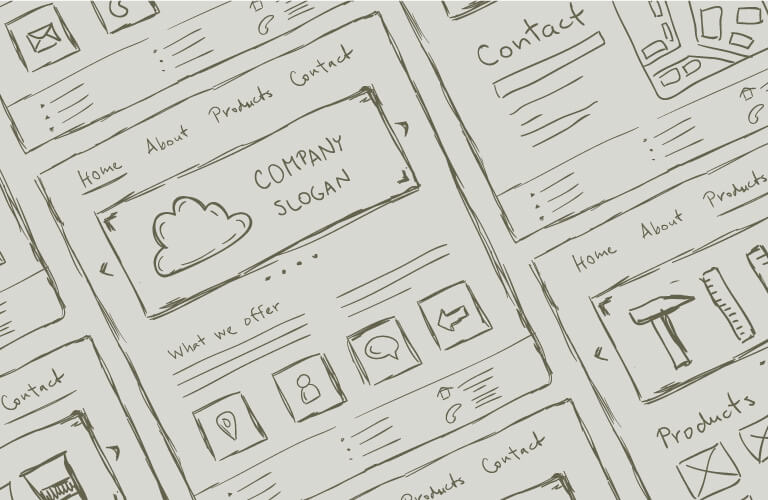
Once you’ve buttoned down user flow, it’s time to build a sitemap. This shows a clearly organised hierarchy of all the pages and child pages within your site, and how a user will get from one page to another. It’s where you map out the user’s journey and see how many clicks it will take them to get to their destination/s.  A site map allows you to eliminate any bad ideas and take on good ones early on, and clearly shows you all the pages you will eventually need to design and write content for.

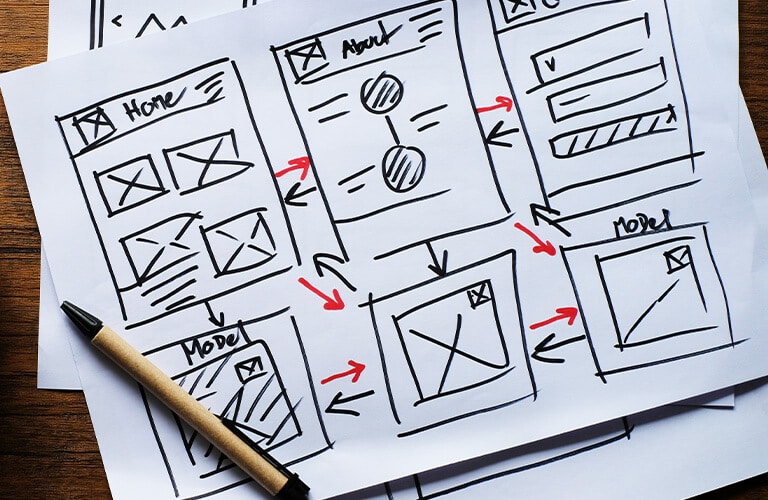
5. Create wireframes for each page.

A sitemap shows you how your site is going to work. Wireframes allow you to see exactly how each page will work.

These visual guides represent a skeletal framework of each page, showing where key messages, images and calls to action sit based on your user research.

6. Time to design.

Drawing on the user personas, our creative team will write content that has the right “tone of voice” and develop a look and feel for the site that will appeal to the user.

This will include using the right user interface (UI) elements, such as module tabs, breadcrumbs and slideshows. We’ll drill down to font sizes, colours, buttons and type layout to ensure your users will have a smooth experience across the entire site.

“Forge combine UX design principles with Design Thinking to create a homegrown UX design philosophy.”

Let’s work together on improving the User Experience of your website.

Thoroughly understanding who your users are and why they are on your site allows us to create a website that delights your customers, enhances your brand and meets your business goals.

Talk to us today about how our Homegrown UX Design process can help you better understand your customers and deliver a website that meets their needs.

Contact Form - Walking in skins and Homegrown UX Design
Subscribe to newsletter

5 ways to better target your audiences on LinkedIn.

Are you reaching the right audience on LinkedIn? Wondering how to better target?

In this article, you’ll discover how to target your ideal audience with LinkedIn Ads.

1. Know who your ideal audiences are.

Having a clear idea who your audiences are will make things easier because you’ll know who to target, where to reach them and how to talk to them in a way that resonates and compels them to become your clients.

Create a detailed buyer persona based on real-time company information.

Why is this so important? A well-defined persona allows you to personalise your marketing messages. When you use personalisation in your messaging and make sure it fits people’s needs, they’re more likely to take you and your business seriously. This focused effort means you can also maximise your return on investment (ROI).

The ad content can be tweaked in editing to create slightly different versions that speak to each persona more clearly and increase the chance of signups.

Remember, the world is always changing: New members are joining LinkedIn and existing members are changing jobs. So don’t forget to update your buyer persona frequently.

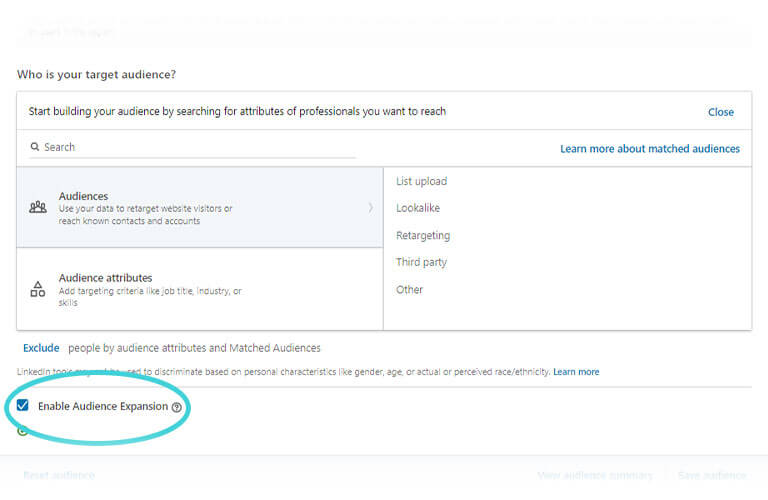
2. Use LinkedIn Smart Audience Expansion features, such as “Lookalike Audiences”.

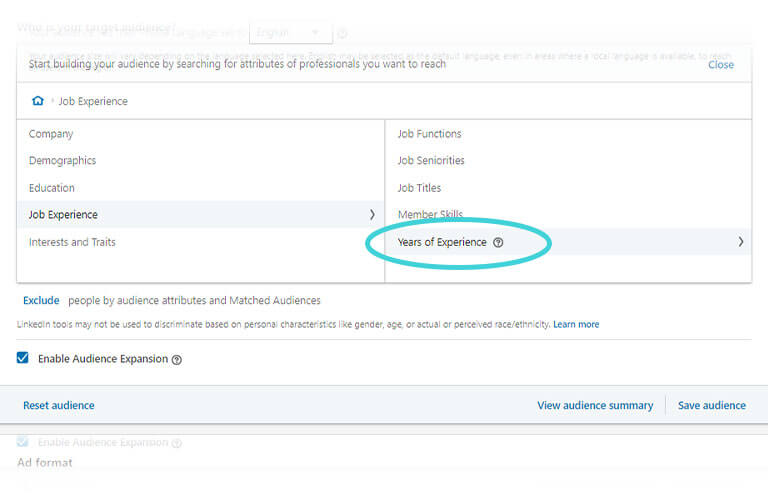
Click the “Enable Audience Expansion” tick box.

This handy feature enables you to increase the reach of your paid ads by serving ads to audiences with similar attributes to your target audience.

Just a caveat here: “Lookalike Audiences” works best when you already have a high performing audience.

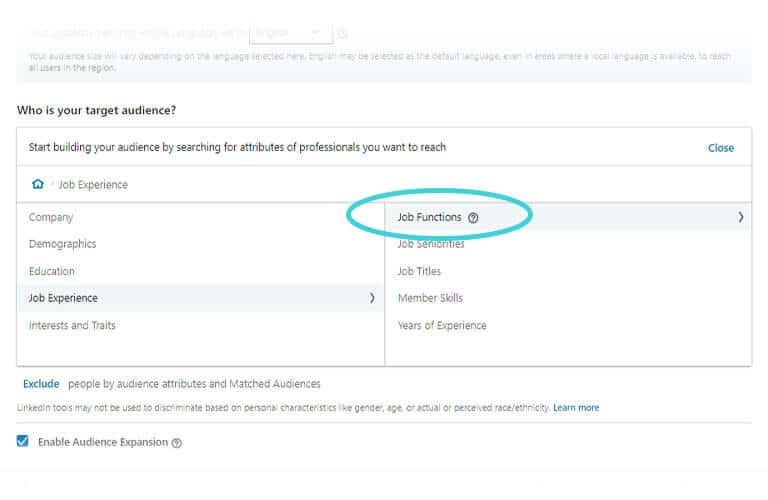
3. Using “Job Functions” instead of “Job Titles”.

This is the broadest targeting available on LinkedIn, which means it gives you access to the largest audience.

Using the attribute “Job Functions” when creating the audience is useful in targeting each persona. Job Function is based on standardised groupings of job titles. This helps create an audience without necessarily selecting all the possible job titles that your persona would be doing. The audience creation is also narrowed down through layers of attributes such as Location, Years of Experience and Job Seniorities.

4. Don’t limit your potential reach by choosing the wrong targeting option.

Targeting by “age” is a good example of this, as it can severely limit your potential audience size. LinkedIn recommends instead that you choose “years of experience”. So think carefully about the search terms you need to use. LinkedIn can provide guidance around this.

5. Use Audience Testing and Demographics Reporting.

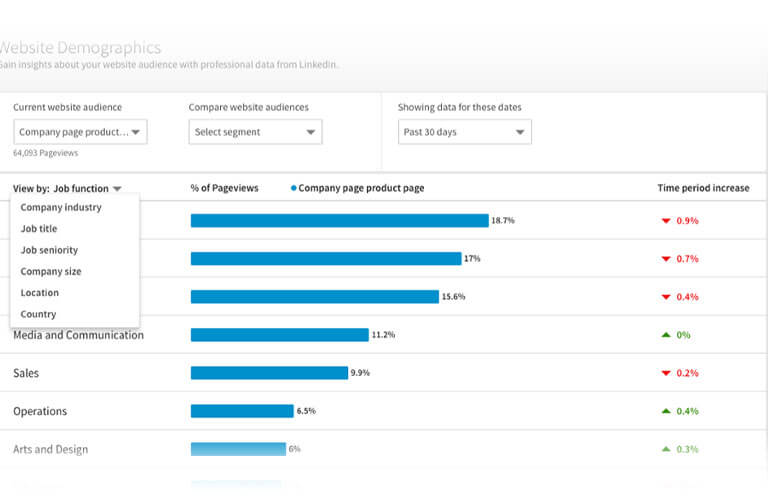
Demographics Reporting is available in your account dashboard.

Build up valuable profiles about your markets using the most accurate professional data that’s only available on LinkedIn.

Create tailored content and compare the results. Compare different pages to learn which type of content resonates with different audience demographics.

Reach your ideal prospects. Use what you learn through website tracking to target website visitors who are most likely to become qualified leads and customers.

Ready to expand with LinkedIn Ads?

Understanding your ideal customer is key to targeting the right prospects with the right message that will engage and motivate them to do what you want them to do.

Contact us for a well-defined strategy.

Contact Form - 5 ways to better target your audiences on LinkedIn
Subscribe to newsletter

Why choose Forge?

We do the thinking. So you don’t have to!

We start every project by talking to you. About your business, challenges and dreams. Then we’ll think about how we can overcome your challenges and fulfil your needs by creating an effective creative solution that works for your business.

We have in-house design and development experts to make that happen. And if the solution requires resources or expertise that we do not have internally, we will partner with our trusted service providers to deliver the right solution for you.

We partner with the best.

We do not take your trust in us lightly. We aim to deliver the best hosting solutions that will suit your needs. That’s why we only work with the best in the field, who have been proven successful in many of our past projects.

Sitehost is a kiwi owned cloud solutions provider that has been growing rapidly since 2004.

WP Engine is recognised as the world’s number one platform for WordPress.

Our proven track record.

Our hard work and commitment to achieving the best solution in all of our projects have been acknowledged and we are very proud of it. Two of our projects were the finalists of Best Design Awards 2020 in the Small Scale Website category. Top Reviews has also acknowledged and put us among the Best Design Agencies in Auckland, as has Design Rush.

Best Design Awards is an annual showcase of excellence in graphic, spatial, product, digital and motion design along with three special awards – Value of Design, Public Good and Toitanga.

Top Reviews is a website that lists the best products and services in New Zealand.

See our profile on Good Firms.

Need a website that portrays what your brand is all about?